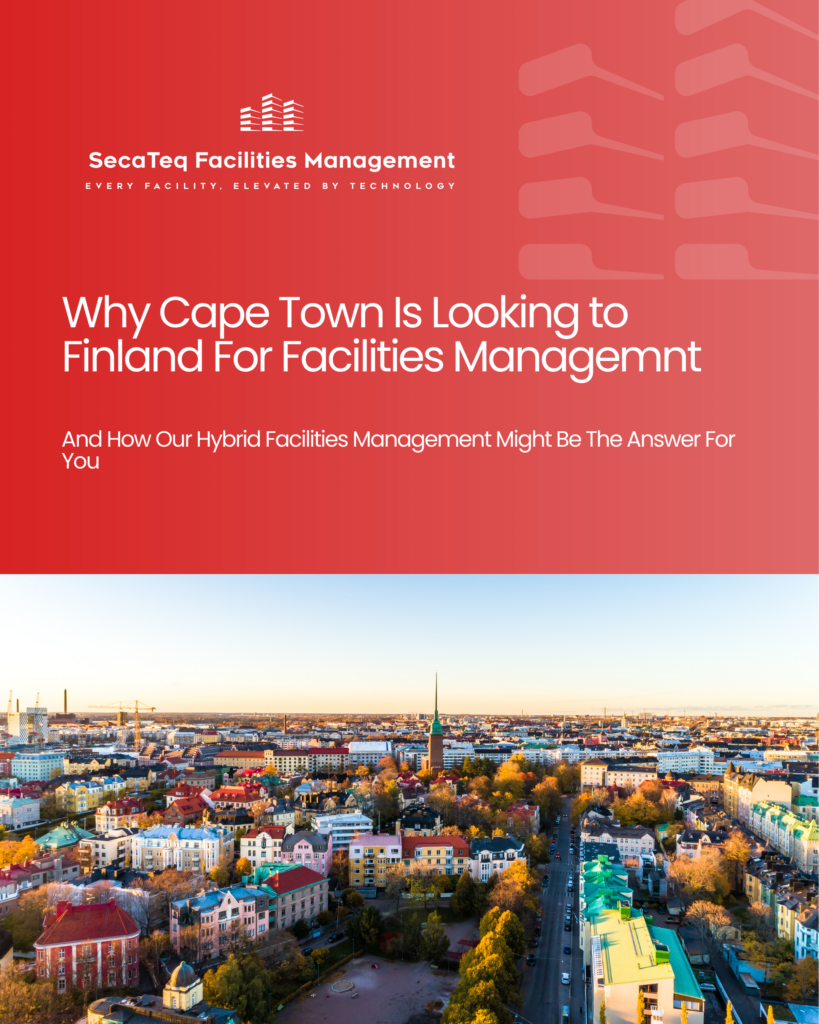
When the City of Cape Town announced its collaboration with Finland to modernise and centralise facilities management, it quietly confirmed what progressive operators already know:
The future of facilities management is data-driven, centralised, and technology-enabled.
The City’s partnership with the Finnish government focuses on applying data analytics, digital planning, and digital twin technology to better manage large, complex asset portfolios. It’s a move inspired by Finland’s position as one of the most digitally advanced governments in the world, and a recognition that traditional, decentralised FM models can no longer keep pace with modern infrastructure demands.
At SecaTeq, this approach feels familiar, because it’s exactly the direction we’ve been building toward.
The Shift: From Reactive Maintenance to Intelligent Management
Historically, facilities management in South Africa (and globally) has relied on:
- Manual logs and paper records
- Fragmented contractor communication
- Knowledge sitting with individuals rather than systems
- Limited long-term visibility for decision-makers
As Cape Town’s Corporate Services leadership has highlighted, data alone isn’t the solution — the real value lies in how that data is captured, structured, and used to guide decisions.
This is where modern FM models begin to diverge sharply from traditional ones
Finland’s Influence: Centralisation, Visibility, and Continuity
Finland’s facilities management philosophy centres on:
- Centralised data platforms
- Long-term asset intelligence
- Digital representations of buildings and systems
- Decisions informed by real operational data, not assumptions
The City of Cape Town’s move toward a Facilities Management Digital Twin Framework is a clear signal that future FM will be less about firefighting and more about foresight.
While digital twins may still sound advanced for many private buildings, the foundations required for them are already achievable today.
How SecaTeq’s Hybrid Facilities Management Reflects This Approach
SecaTeq’s Hybrid Facilities Management model applies these same principles in a practical, scalable way for residential and sectional title buildings.
Instead of replacing trusted caretakers or building managers, we centralise the system around them.
Our Hybrid FM model introduces:
- A cloud-based Building Management System (BMS)
- Digital job logging and maintenance tracking
- Centralised compliance documentation
- Contractor coordination with full audit trails
- QR code reporting for residents and staff
- Structured reporting for trustees and managing agents
In simple terms:
The knowledge no longer lives in one person’s head , it lives in the system.
This mirrors the same logic behind Finland’s digital FM strategy: continuity, transparency, and data-led decision-making.
Why This Matters for Cape Town Buildings Right Now
Cape Town’s building stock is ageing, complex, and increasingly scrutinised for compliance, cost control, and operational resilience.
Whether managing 200 municipal facilities or a 120-unit residential scheme, the risks are the same:
- Information loss when staff change
- No visibility into maintenance patterns
- Delayed responses due to poor reporting
- Trustees and owners forced to make decisions without reliable data
Hybrid Facilities Management solves this by delivering centralised intelligence without the cost of a full-time Facilities Manager.
A Practical Step Toward the Future of FM
The City of Cape Town’s collaboration with Finland signals where facilities management is heading.
SecaTeq’s Hybrid FM model is about bringing that future into today’s buildings, in a way that is affordable, realistic, and designed for South African conditions.
You keep your people.
You gain structure, visibility, and continuity.
And your building becomes easier to manage, year after year.
That’s not theory.
That’s modern facilities management in action.